
The ability to regulate and control traffic flow is one of the automatic bollard system's key benefits. Automatic bollards can block off certain areas or direct traffic to a specific lane. This is especially useful if you want to create separate lanes for parking, pedestrians, and vehicles.
Automatic bollards can also be used to create a barrier between a public area and a private area. For example, if you have a business that deals with sensitive information, you might want to consider installing an automatic bollard system to keep unauthorized people from entering the premises.
Another benefit of automatic bollards is that they can enhance the aesthetics of your property. Bollards come in a variety of materials, colors, and styles. You can choose bollards that match the architecture of your building or go for a more modern look. Automatic bollards can also create a unique and stylish design for your property.
Automatic bollards are easy to install and low maintenance, so you won't have to spend much on repairs and maintenance. Bollards can also be used in various applications, such as parking lots, driveways, sidewalks, etc.
Automatic bollards can also increase the safety of your property. Bollards can be used to create a physical barrier between pedestrians and vehicles. You can avoid accidents and injuries by installing them in your commercial area. Bollards can also be used to deter crime. They can make it more difficult for criminals to access your property, which can help to reduce the chances of theft or vandalism.
There are three main types of automatic bollards that are typically installed at medium to high-security facilities like corporate campuses, public event spaces, and government buildings:

Hydraulic
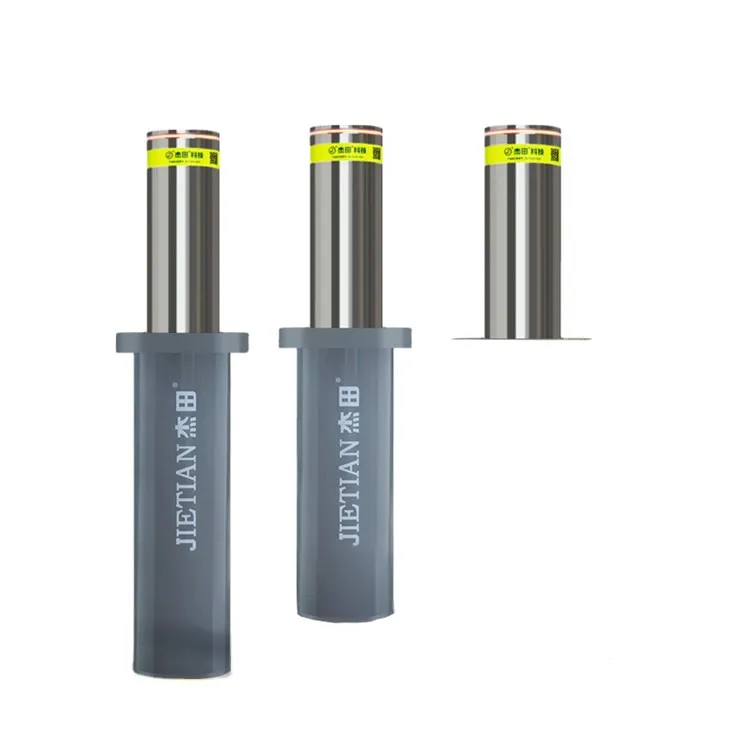
A Retractable Hydraulic Bollard System uses fluid, a generator, and a pump system. The fluid expands in and out of the system and pushes air to compress the motor cylinder. This type of operation is generally the fastest and the system can raise in just seconds.
Electric
A Retractable Electric Bollard System is driven by an electric motor that operates the cylinder piston to raise or lower the bollards. This type of operation has the most consistent speed and is often quieter when activated.
Pneumatic
A Retractable Pneumatic Bollard System uses compressed air to operate the cylinder piston, raising or lowering the bollards. This type of operation is the simplest, least expensive, and typically requires less maintenance over time.

While automatic bollards can offer a wide range of benefits over static bollards and manually retractable bollards, there are some things to consider:
· Like all mechanical devices, automatic bollards can experience malfunctions such as failure to fully retract or extend. A bollard that isn't sitting flush with the ground can also create a potential tripping hazard.
· Automatic bollards require regular maintenance to ensure longevity and proper operation.
· Unauthorized or accidental operation: As most methods of operation utilize some form of remote control, it's important that those controls are secure and only accessible to authorized operators. It's also important that operators have a clear view of the bollards when they are raising or lowering them, to avoid accidentally obstructing moving vehicles or pedestrians.
Composition and Mechanism
Automatic rising bollards are typically constructed with a combination of strong materials such as stainless steel or aluminum to ensure durability and functionality. The three essential components of these bollards are the column part, the control system, and the actuator. In terms of the power system, automatic bollards can have pneumatic, hydraulic, or electric rising mechanisms that raise the bollard from a recessed location in the ground to an upright posture.
Electronic Bollard Mechanism: An electromotor is used to drive a shaft, which rises and lowers the bollard. In comparison to other mechanisms, electronically driven bollards provide the best precision and control while operating quietly.
Pneumatic Bollard Mechanism: Pneumatic motors use compressed air to move the cylinder upward, raising the bollard. This technology is cost-effective because it requires less maintenance.
Hydraulic Bollard Mechanism: A pump pushes an incompressible liquid into the cylinder to elevate bollards using hydraulic systems.
Control Method
Automatic bollards can work just like any other access control barrier. Depending on the desired individual requirements, complexity, and features, different types of control systems can control these bollards. Remote controllers, simple timer-based systems, and vehicle identification systems, to name a few, are some of the most popular systems used for managing bollards; however, advanced systems often use mobile apps for operation.
Rising and Lowering
The control system will receive a signal when a vehicle approaches an area with automatic raising bollards, either directly from the person who is operating the system or via a vehicle detection system like cameras or sensors. After authorization has been given to the vehicle or individual, the control system sends a signal to lower the bollards, enabling the vehicle to proceed. Once the vehicle has successfully passed through, the bollards revert to their upright position automatically, restoring regular traffic conditions.
It's important to recognize that the features and capabilities of automatic telescopic bollards can differ based on the manufacturer and their intended use, which means that various models may differ when it comes to speed, power supply, control systems, and safety features.
Automatic bollards can function in different modes to suit various access control scenarios:
Automatic Mode
In this mode, the bollards automatically rise when a vehicle is detected by sensors or when a valid access control device is presented. Once the vehicle passes, the bollards automatically lower to allow the flow of traffic.
Semi-Automatic Mode
In this mode, a user initiates the bollard's movement using a remote control or an access control device. The bollard remains in the raised position until manually lowered.
Manual Mode
Manual mode allows the user to raise or lower the bollard on demand using a physical key or control device.
Bollards on the market today come in a variety of materials. Some materials offer unique benefits that make them the best choice for specific applications. For example, aluminum is exceptionally lightweight, making it a good choice for bollards meant to provide more of a visual delineation than a heavy-duty barrier. When you need a strong, durable bollard, steel is an excellent choice.
As part of our commitment to offering bollards produced from only the best materials, all automatic bollards are manufactured from high-grade stainless steel. A stainless steel bollard will provide superb resistance to corrosion, making it a good choice in wet and humid climates. Stainless steel is also less susceptible to pitting and staining than many other materials, helping to maintain the bollard's aesthetic appeal.
In addition, stainless steel requires less maintenance and is considered an environmentally friendly material alternative. You can even paint or powder-coat stainless steel.

Applications Suited to Automatic Bollards

Automatic retractable bollards bring key advantages anywhere requiring regular access changes, rapid reactions to threats or remote oversight where manned supervision is impractical.
Typical applications include:
Almost any environment needing robust rising bollards can benefit from automation. Intelligent functionality tailored to each site's risks and traffic flows takes convenience and security to the next level.
What's the Difference Between Manual and Automatic Bollards?
Manual retractable bollards require manpower to pull them up into place or push them back into the ground. They are operated using a single-key locking mechanism.
Automatic bollards are controlled by a remote control or access control system using hydraulic or pneumatic technology.
Another common security system for restricting traffic is the arm barrier. Both systems are designed to restrict traffic, but they tend to be used in different areas.
The most obvious difference between retractable bollards and arm barriers is the way they're positioned to restrict traffic. Bollards move up and down vertically, whereas barrier arms create a horizontal barrier to entry.
As bollards tend to work best in pedestrian areas because they're easy for people to walk through while still restricting vehicles.
Because barrier arms are fixed horizontally, they don't tend to work for this purpose as they're much harder for members of the public to walk through. Instead, you'll most likely see barrier arms at the entrances and exits of commercial car parks and buildings.
.
When purchasing automatic retractable security bollards, the following points should be noted:
Width of the passage: The width of the passage determines the number of equipment required. If we only need to intercept vehicles normally, we only need to ensure that the distance between each bollard is not more than 1.5 meters, but in most cases this distance will be maintained at 1.2 meters.
Different places may have slight differences in width requirements. For example, in our park square, we may not only need to block illegal entry of vehicles, but also need to intercept some electric or tricycles, so our spacing may be between 60cm and 80cm. In short, we need to control the spacing width according to our actual needs based on different usage places.
Traffic flow: This number is one of the important parameters for selecting a product, but users often overlook this parameter. Understand the total annual/monthly traffic flow and average daily traffic flow of the installation site first.
Frequency of use: It is important to understand the short-term traffic flow during peak hours on the road where the vehicle is used.
Rising speed: This parameter is often of concern.
Safety level of the place of use: Although all automatic bollards have the function of blocking vehicles, there is indeed a huge difference in the blocking effect of civilian products and professional anti-terrorism products on vehicles.
Group management: Whether to separate lane access or manage by lane grouping determines the configuration and selection of the entire control system.
Rainfall and drainage: Due to the fact that the automatic bollards need to be buried deep below the ground, in extreme weather, automatic bollards will be soaked in water. If the location where the automatic bollards are located often has rainstorms or the drainage system is not in place, when selecting equipment, at least select equipment with a grade of ip67 or above, so as to better ensure safety.
Location of installation site: If the installation site belongs to a geographically remote area, when selecting equipment, it is important to consider whether the selected equipment is easy to maintain and whether spare parts are convenient to purchase.
Implementation of protection function: Automatic bollards can achieve safety protection through external infrared or vehicle monitors. Due to the fact that fully automatic hydraulic bollards are used to manage vehicles, the practice of vehicle detectors is more common.
Our Factory
Xiamen Jietian Technology Co.,Ltd established in 2006,is a professional manufacturer engaged in the research,development sale and service of Bollard,Road Blocker,Tire Killer,License Plate Recognition System,Barrier Gate,Car Charging Pile etc and other anti-explosion one-stop facility solutions provider.
Xiamen Jietian Technology Co.,Ltd with years of product research and development, continuous innovation and product sales network throughout the country, serving more than 100,000 customers, exported to Italy, Britain, Germany Countries, Japan and other parts of the world.
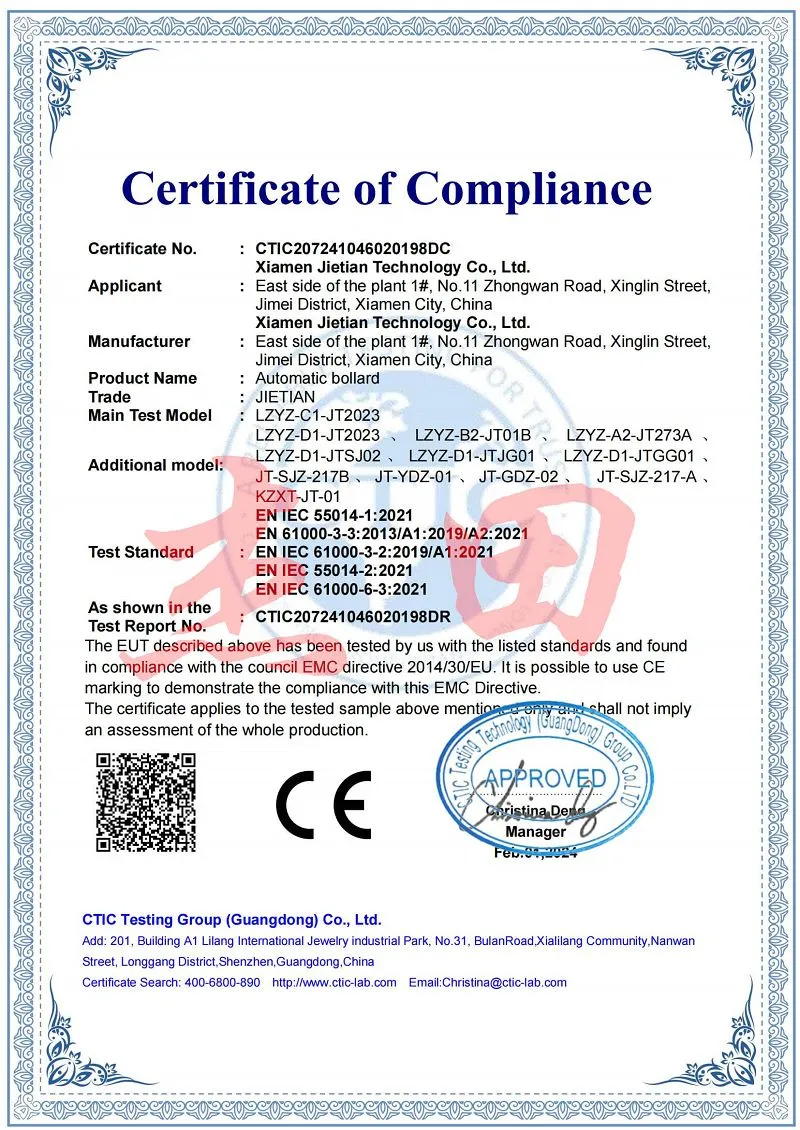
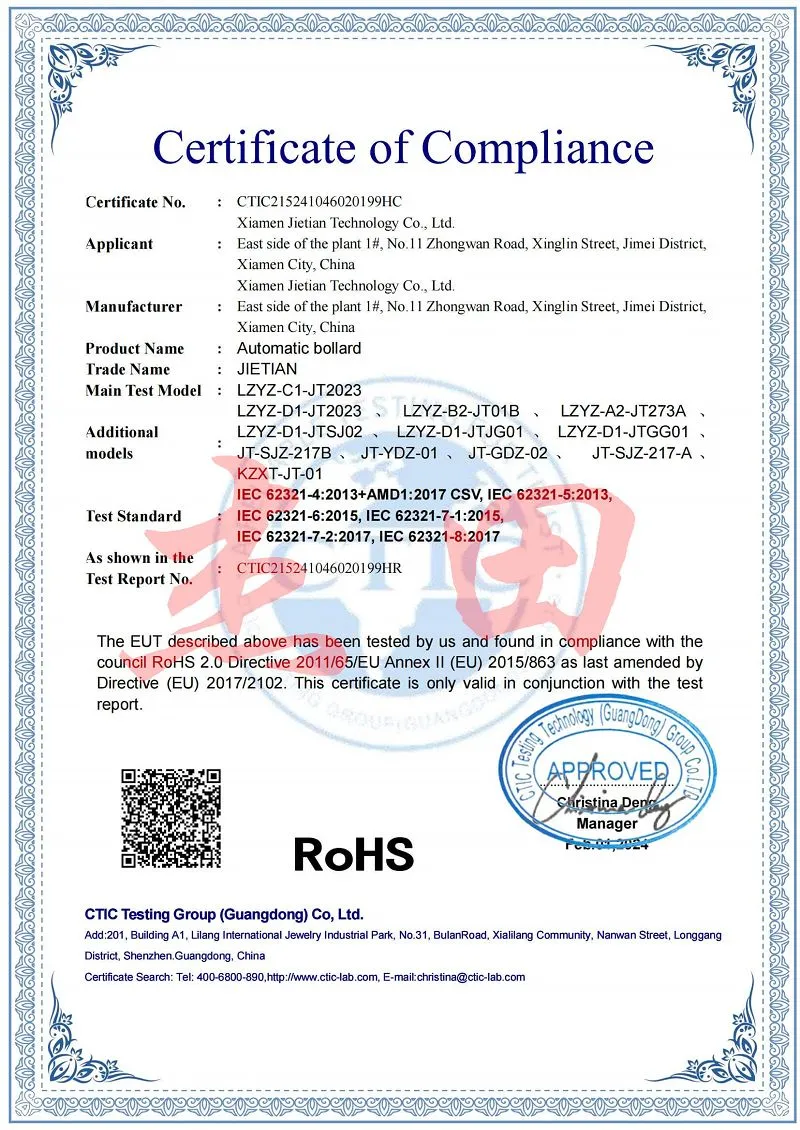


We're professional automatic bollards manufacturers and suppliers in China, specialized in providing high quality customized service. We warmly welcome you to wholesale high-grade automatic bollards made in China here from our factory.
electric automatic bollards, automatic rising bollards, driveway bollards(0/10)



