
A turnstile is a mechanical or electronic gate that allows the passage of individuals in one direction while restricting or preventing movement in the opposite direction. Turnstiles have various uses and benefits in different settings, including:
Crowd control
Turnstiles are commonly used in public transportation systems, stadiums, amusement parks, and other crowded areas to manage the flow of people. They ensure orderly entry and exit, prevent overcrowding, and help maintain security.
Access control
Turnstiles are often employed in buildings, offices, and other restricted areas to regulate entry and ensure that only authorized personnel or ticket holders can enter. They provide a physical barrier and help prevent unauthorized access, improving overall security.
Ticket validation
In transportation hubs, turnstiles are used to validate tickets or passes. Users need to insert or swipe their ticket to gain entry, ensuring that only valid tickets are used for travel. This helps in reducing fare evasion and maintaining revenue for the transport system.
Time and attendance tracking
In workplaces or educational institutions, turnstiles can be equipped with electronic systems to track the entry and exit times of employees or students. This data is useful for attendance management, calculating work hours, and monitoring punctuality.
Safety and security
Turnstiles can enhance safety measures by ensuring that people pass through a designated entrance or exit point, reducing the risk of accidents or unauthorized access. In high-security areas, turnstiles can be integrated with access control systems, such as biometric scanners or ID card readers, to further enhance security protocols.
Counting and analytics
Some modern turnstiles are equipped with sensors or cameras that can count the number of people passing through. This data can be analyzed to monitor crowd density, analyze foot traffic patterns, and optimize operational efficiency in various environments.
Queue management
By enforcing a single-file entry system, turnstiles can help manage queues effectively. They prevent line-cutting or overcrowding, ensuring a fair and organized waiting experience for individuals.

Turnstile gate arms can be designed to rotate in one direction or in both directions to control both entry and exit. Some controlled access turnstiles, such as a speed gate turnstile or a glass swing turnstile, can feature doors rather than arms, but the basis of operation is the same: only one person at a time with credentials or tickets will be granted access.
Single security turnstiles can be deployed to control access to a space or may be installed in multiple lanes to make access convenient for large crowds and minimize delays. Multiple lanes are generally used in busy venues, such as train stations or sports stadiums.
Venues attracting large crowds may also use portable turnstile gates to control access in areas where different events are hosted, such as a stadium set up for a basketball game on one day and for a concert on a different day. Depending on the event, different access points that are not protected by the venue's security might need to be secured with portable waist-high turnstiles. A large area that hosts a festival or trade show will also benefit from using portable turnstiles, as the spaces cannot accommodate permanent forms of security turnstiles.
Turnstile entry systems are controlled electronically. When sensors or readers recognize valid credentials, the electronic turnstile locking mechanism is released to allow access. Security turnstile manufacturers such as full-height turnstile manufacturers also produce models that allow teams to operate turnstile gates manually for establishments that require a more hands-on approach to security or depend on a stricter verification process for entry.
Be it residential complexes, or commercial spaces, boom barriers are used to secure their premises. To ensure longer life of these crucial components of the security systems, comprehensive training and establishment of clear emergency protocols such as use of radio controls or turning off loop detectors, is a must. This enhances the overall effectiveness of the system as well.
Safety Devices
Barrier systems are equipped with safety features such as photocells and safety edges. Regularly test these devices to ensure they are functioning correctly. Replace any damaged or malfunctioning safety components promptly.
User Training
Ensure that personnel responsible for operating or maintaining the barrier system are adequately trained. Proper training reduces the risk of mishandling, which can lead to damage or accidents.
Emergency Protocols
Establishing clear emergency protocols, for the case of a barrier malfunction, is crucial. Users should know how to manually operate the barrier or safely secure the area in the event of a system failure.
The function of the turnstile gate is to regulate pedestrian access, through the mechanisms of personnel movement track and behavior identification detection, an anti-pinch mechanism for illegal entrants, emergency response treatment in case of emergency, etc., which are the basis for ensuring the high security of pedestrian access control turnstile.
The turnstile gate is equipped with a certain number of infrared radiation detection points at different positions on the inner side of the channel. When people pass through, their limbs block the detection points. Multiple detection points form an effective identification of the movement track and ticket checking behavior of the passing people and make logical judgments through the central controller to drive the response action of the turnstile rod.
The high-end pedestrian turnstile gate adopts LED high-density matrix infrared detection to judge the position, area, state, traffic direction, and the effectiveness of authorization verification of pedestrians in the passage, calculate and analyze, so as to make a corresponding judgment and protect pedestrian safety. When the turnstile is closed, the blocking rod will immediately become free after encountering the obstruction of objects, so as to prevent the passage personnel from being injured and ensure the personal safety of our pedestrians.
The pedestrian access control turnstile equipment shall reserve fire signals. When receiving fire signal warning or power failure and other special circumstances, the blocking rod will automatically fall off, forming an obstacle-free passage for emergency evacuation of people. Ensure the safe evacuation of pedestrians in case of emergency.
When pedestrians accidentally hit the swing rod, the swing rod will not be directly stuck, but can be pushed forward slowly for a short distance to buffer the impact force on the movement and the reversed impact force on pedestrians, so as to protect the mechanism and pedestrians.
The two ways to prevent tailgating are the use of physical barriers and/or optical sensors. Optical turnstiles use sensor beams to detect passage. These barrier free optical turnstiles alert security guards of possible piggybacking or tailgating with visual and/or audible alerts. Physical anti-tailgating barriers include full height turnstiles, waist high turnstiles, and barrier optical turnstiles that only allow access to a single person at a time.
Pedestrian tailgating is a security vulnerability for all automated access control systems. Anti-tailgating access control systems are used to minimize this risk and ensure that only people with proper credentials gain access to a secured area. In any situation where you want to ensure only one person gains access per card swipe, badge scan, or biometric scan, you should use an anti-tailgating access control solution featuring turnstiles.

No matter when and where security comes first, there has always been a lot of controversy about whether the turnstile gate is safe or not. Especially in the past few years, when the pedestrian turnstile gate technology is not very mature, the news about the turnstile security gate hurting people is also reported from time to time, and people have always had a lot of doubts about the security of the turnstile gate, Since engaging in this industry, we often hear customers ask questions about what kind of turnstile gate is the safest.
When passing through the turnstile gate, we often hear people shouting. People come and go in the turnstile gate channel. We must always pay attention not to catch people, especially children. In case of power failure, the turnstile gate can still open door. Don't hinder the entry and exit of the crowd. Especially in the case of an emergency disaster, it can't affect the escape speed. The turnstile security gate still plays many roles in helping safety management!
The turnstile gate is a pedestrian access control management equipment. It is self-evident how important is the safety of the turnstile gate. The turnstile security gate itself is a kind of security access control equipment, which is to ensures everyone's safety. Therefore, the security of the turnstile gate itself is the most basic requirement. In today's society, safety comes first and safety is the most expensive.
Our Factory
Xiamen Jietian Technology Co.,Ltd established in 2006,is a professional manufacturer engaged in the research,development sale and service of Bollard,Road Blocker,Tire Killer,License Plate Recognition System,Barrier Gate,Car Charging Pile etc and other anti-explosion one-stop facility solutions provider.
Xiamen Jietian Technology Co.,Ltd with years of product research and development, continuous innovation and product sales network throughout the country, serving more than 100,000 customers, exported to Italy, Britain, Germany Countries, Japan and other parts of the world.
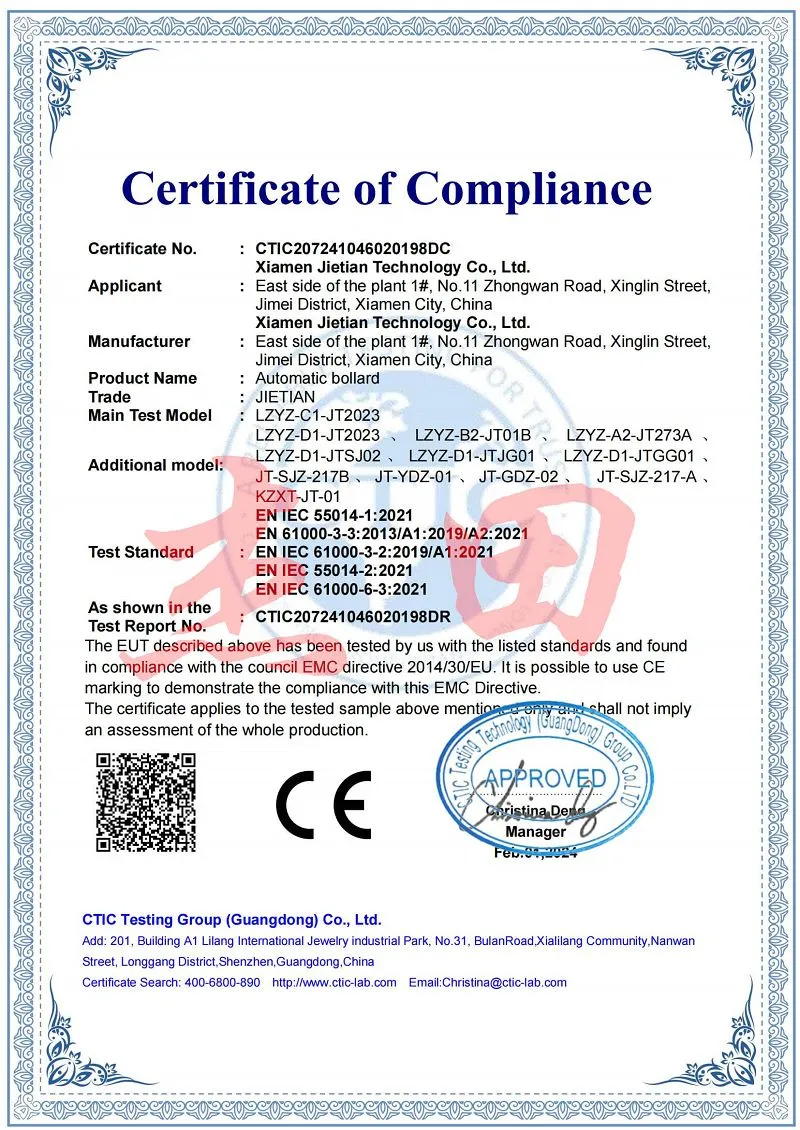
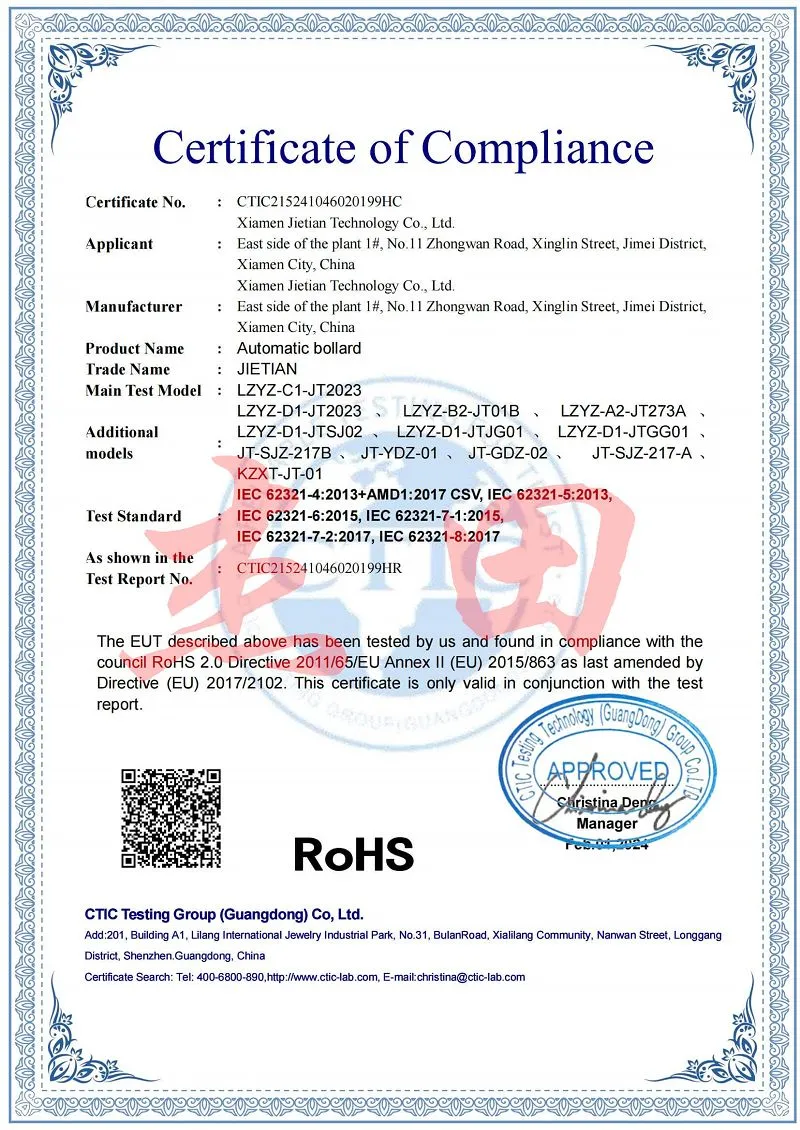


We're professional turnstile gate manufacturers and suppliers in China, specialized in providing high quality customized service. We warmly welcome you to wholesale high-grade turnstile gate made in China here from our factory.
glass swing turnstile, vertical tripod turnstile, tripod security gates(0/10)



